
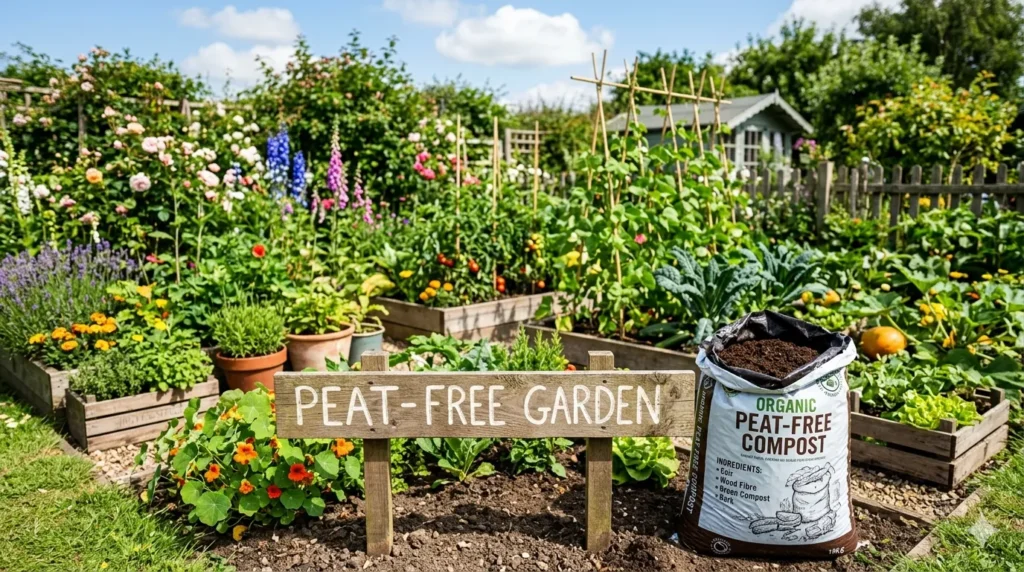
You have likely seen labels promoting peat-free gardening at your local garden centre. But what does choosing peat-free gardening really mean for your backyard, and why should you care? Here is the truth: peat-free gardening is not just a passing trend—it is one of the most impactful choices you can make for the planet.
Why Peat-Free Gardening Matters
Peat extraction destroys vital habitats, releases stored carbon, and contributes to climate change. Yet, because of its ideal growing properties, peat was the go-to ingredient for decades. By adopting peat-free gardening techniques, you help protect unique ecosystems that take thousands of years to form.
The good news is that alternatives for peat-free gardening have improved dramatically in recent years. Today’s mixes are often just as effective – or even better – than their peat-based counterparts. In this guide, I will walk you through why peat-free gardening matters, the best alternatives available, and how to achieve great results in your own garden.
The Environmental Case
Peat bogs are extraordinary places. These wetlands are home to rare plants, insects, and wildlife – from jewel-like dragonflies to fluffy cotton grass. Yet lowland raised bogs, the main source of peat for gardening, have been decimated. Only around 5% of this habitat remains in the UK.
The problem with peat extraction:
- Carbon release: Draining and digging peat exposes it to air, causing it to oxidise and release thousands of tonnes of CO₂ into the atmosphere.
- Habitat loss: Peat extraction destroys unique ecosystems that take thousands of years to form.
- Flooding risk: Healthy peatlands absorb excess rainfall, helping to prevent localised flooding. Damaged bogs lose this ability.
The scale of the issue: In 2021, around 1 million cubic metres of peat were still being used for amateur gardening products alone. Retail accounts for the vast majority of peat use as a growing medium.
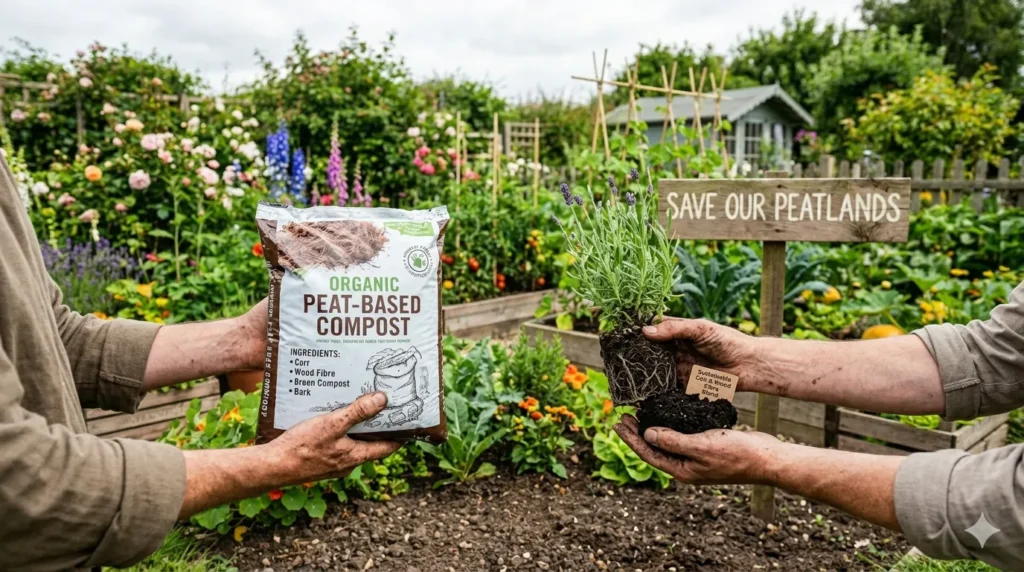
The International Union for the Conservation of Nature (IUCN) puts it simply: “Peat belongs in bogs, not bags!”
Pin-worthy tip: “A bag of peat-free compost saves a piece of a 10,000-year-old habitat. Every bag counts.”
The Main Peat-Free Alternatives: What’s in the Bag?
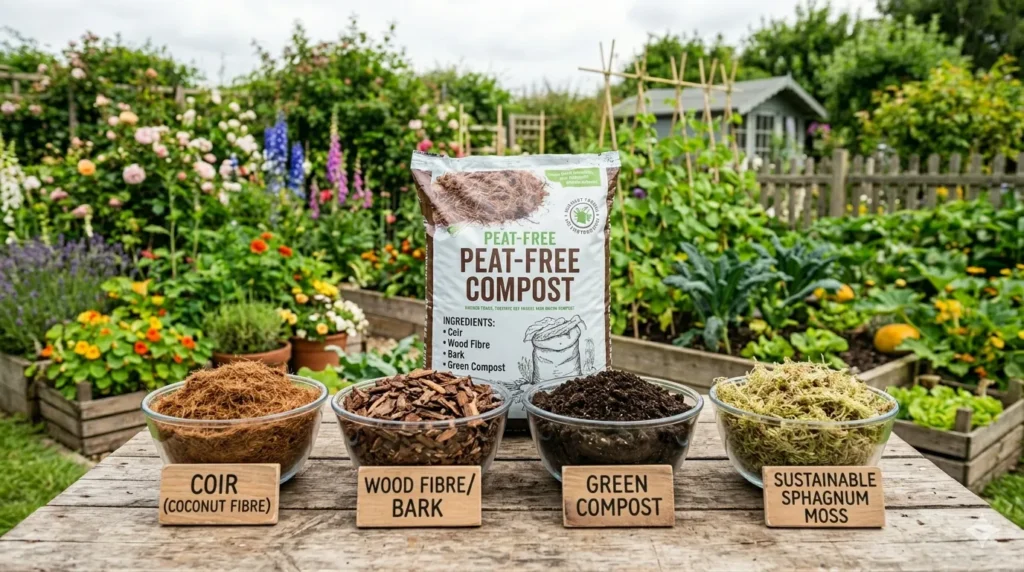
Peat-free composts are blends of various organic and inorganic materials. Each has different properties, so it’s worth trying a few to find what works best for your plants.
🌿 Coir (Coconut Fibre)
Coir is made from coconut husks, a by-product of the coconut industry.
Pros:
- Excellent water-holding ability
- Light and porous – good for root growth
- Fine and coarse fibres create an ideal growing structure
Cons:
- Low nutrient content – needs fertiliser added
- Mostly imported from Sri Lanka and India – consider the carbon footprint
- Production can be water-intensive (300-600 litres per cubic metre of coir pith)
- May not hold nutrients as well as other materials
Best for: Versatile use as a peat substitute in blended composts.
🌳 Wood Fibre and Bark
Wood-based materials are by-products of the timber industry. They can be processed in different ways to suit different needs.
Pros:
- Adaptable – can be tailored for drainage or fine texture
- Long-lasting and structurally stable
- Steam-treated wood fibre provides a loose, airy mix; crushed fibres improve drainage
Cons:
- Low in nutrients – needs extra fertiliser
- Competition from energy industries for wood products
Best for: Soil improvement, mulching, and as a structural component in potting mixes.
🟢 Green Compost
Made from garden waste collected by local authorities and processed through anaerobic digestion.
Pros:
- High nutrient content
- Supports circular economy – recycles garden waste locally
- Subject to industry standards (PAS 100) to ensure quality
Cons:
- Can be variable in quality without careful management
- Quality depends on the cleanliness of materials collected
Best for: Potting composts, mulching, and soil improvement.
🌾 Sphagnum Moss
Sphagnum moss is the living moss layer that grows on top of peatlands – and contributes to the formation of peat.
Pros:
- Similar characteristics to peat – high water retention and structural stability
- Can be sustainably farmed on degraded peatlands undergoing restoration
Cons:
- Newer alternative – may not yet be widely available or affordable
Best for: A broad variety of plants, including decorative plants and food crops like lettuce and tomato.
🐑 Sheep’s Wool
Waste sheep’s wool is an emerging alternative that would otherwise be discarded.
Pros:
- High nitrogen content
- Good water retention
- Nutrients are released slowly – ideal for vegetable gardening
Best for: Vegetable gardening in beds, pots, or containers.
The Quality Question: Are Peat-Free Composts as Good?
The simple answer is yes – but with a few adjustments.
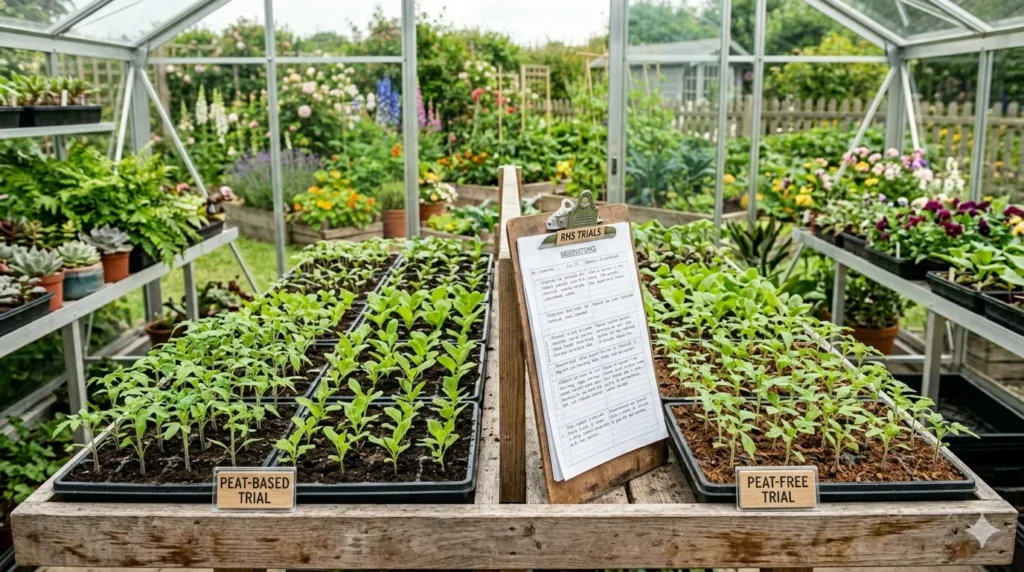
The RHS has tested peat-free alternatives extensively. Their comparative experiments show that plants grown in peat-free alternatives are of comparable quality to those grown in peat. In fact, for some specialist plants like carnivorous plants (pitcher plants), peat-free mixes produced higher-quality plants than peat-based options.
Top growers have already gone 100% peat-free. Jonathan from British Cosmos says: “How things are grown has to be as important as the appearance of what we grow. Gardeners can grow pretty much any plant they want peat-free in the home environment.”
The key is adapting your approach:
| Aspect | Peat-Based Compost | Peat-Free Compost |
|---|---|---|
| Watering | Less frequently, deeper | Little and often – check moisture below the surface |
| Feeding | Later (peat is low in nutrients) | Earlier – when first true leaves appear |
| Texture | Standard | Varies – choose the right mix for your purpose |
Pin-worthy tip: “Peat-free works best when you adjust your watering and feeding. The plants don’t mind – they just want the right care.”
How to Choose the Right Peat-Free Compost
For Seeds and Cuttings
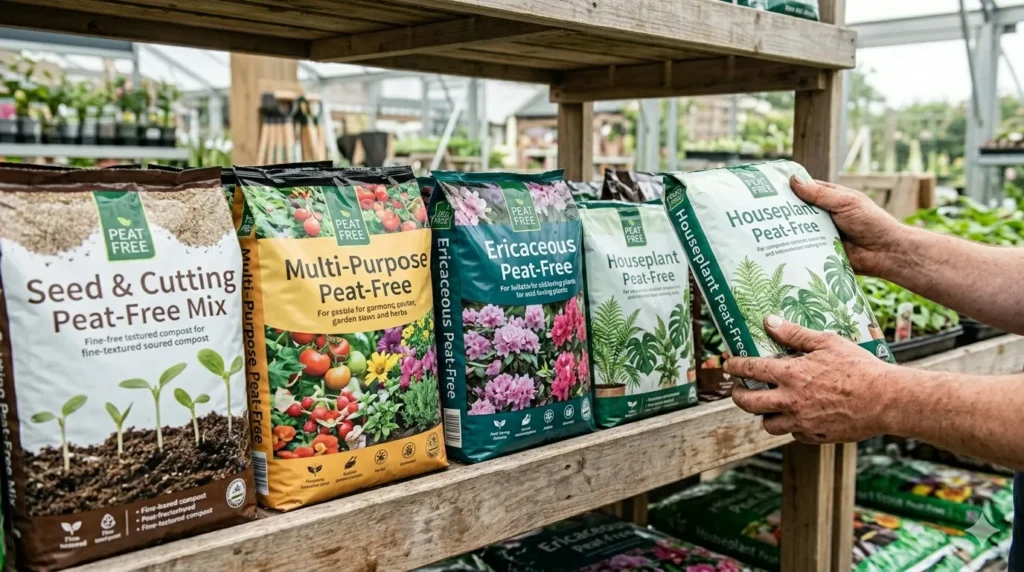
Use a specific seed and cutting in peat-free compost. These are milled to a fine texture, essential for smaller seeds, and contain fewer nutrients.
Top tips:
- Choose a product labelled for propagation
- Water carefully – peat-free seed compost holds moisture differently
- Use a mist sprayer to control watering
For Potting On and Containers
Use peat-free multi-purpose or potting compost, which contains more nutrients.
Top tips:
- Check the packaging – some mixes are tailored for specific plant types (ericaceous, houseplants, etc.)
- Look for the Responsible Sourcing Scheme logo – it rates ingredients on environmental criteria
For Beds and Borders
Don’t use bagged compost on your beds and borders – it’s a waste of resources. Instead:
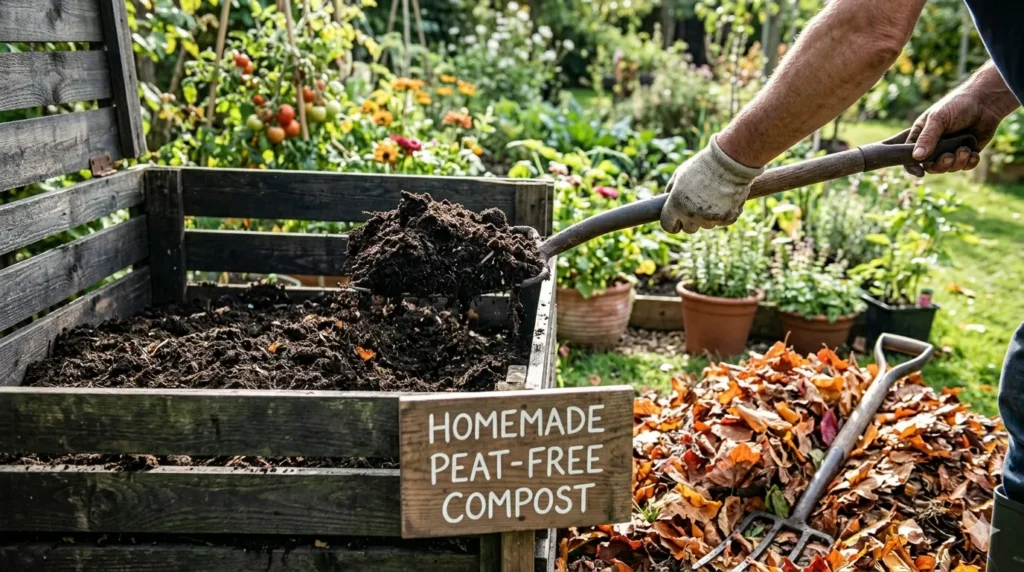
- Use homemade compost – it’s free and reduces waste
- Apply leaf mould – great for mulching and soil improvement
- Use well-rotted manure – perfect for soil improvement
Pin-worthy tip: “Save bagged compost for pots and containers. For beds, homemade compost is free, green, and brilliant.”
Homemade Peat-Free Compost: The Ultimate Green Option
Making your own compost is the most sustainable option – and it’s surprisingly easy.
Ingredients for a simple blend:
- 1 part mature garden compost
- 1 part garden soil
- 1 part sand, gravel, or wood fibres
Leaf mould (free and simple):
- Collect leaves, store in a chicken wire frame, keep damp
- Young mould (under 2 years) – use as mulch
- Well-rotted mould (over 2 years) – use for seeds or potting mix
Pros:
- Low cost (essentially free)
- Reduces garden and kitchen waste
- Provides habitat for minibeasts
- Cuts your carbon footprint
Cons:
- Results can be variable – pH, moisture, and nutrients differ
- Best avoided for seed sowing – potential fungi can harm seedlings
Common Myths About Peat-Free Gardening
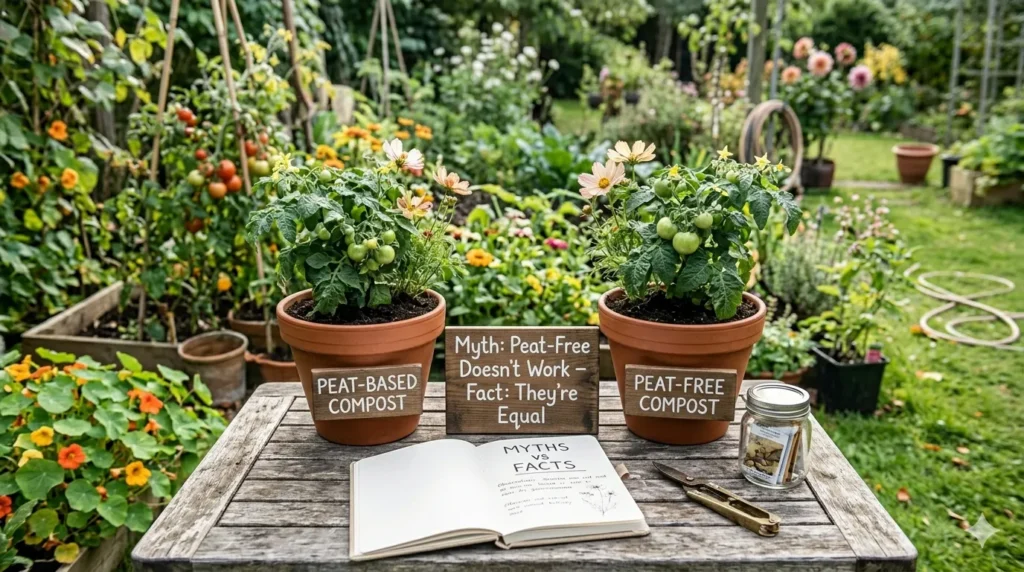
❌ Myth: Peat-free composts don’t work as well.
✔️ Reality: RHS trials and professional growers prove they’re just as effective – often better.
❌ Myth: ‘Environmentally friendly’ and ‘organic’ labels mean peat-free.
✔️ Reality: They don’t necessarily mean peat-free. Check the bag carefully.
❌ Myth: Home-made compost is too variable.
✔️ Reality: It’s variable – but for beds and borders, that’s fine. Save shop-bought compost for seeds and propagation.
❌ Myth: Peat-free compost is hard to find.
✔️ Reality: Most garden centres now stock a good selection, and options are increasing.
You Might Like How to Create a Zero-Waste Garden
Quick Reference: Peat-Free Alternatives at a Glance
| Alternative | Best For | Key Benefit |
|---|---|---|
| Coir | Versatile use | Excellent water retention |
| Wood fibre | Soil improvement, mulching | Structural stability |
| Green compost | Potting, mulching | High nutrient content |
| Sphagnum moss | Decorative plants, food crops | Similar to peat |
| Sheep’s wool | Vegetable growing | High nitrogen, slow release |
| Homemade compost | Beds, borders | Free, sustainable, low-carbon |
Pin-worthy tip: “The best peat-free compost is the one that suits your plants – try a few and see what works.”
Let’s Talk About Your Peat-Free Journey
Now I want to hear from you.
Are you ready to commit to peat-free gardening? Drop a comment below or tag @ouladeco on Pinterest
with a photo of your success. Your garden is not just good for your plants – it’s good for the planet.
And if this guide helped you, save it, share it with a fellow gardener, and come back to Oula Deco for more sustainable gardening inspiration. Your peat-free garden is not just good for your plants – it’s good for the planet.
Peat-free gardening alternatives and benefits – coir, wood fibre, green compost, sphagnum moss, and homemade options. Save this guide to gardening greener! 🌱 ♻️ #PeatFreeGardening #SustainableGardening #OulaDeco

